
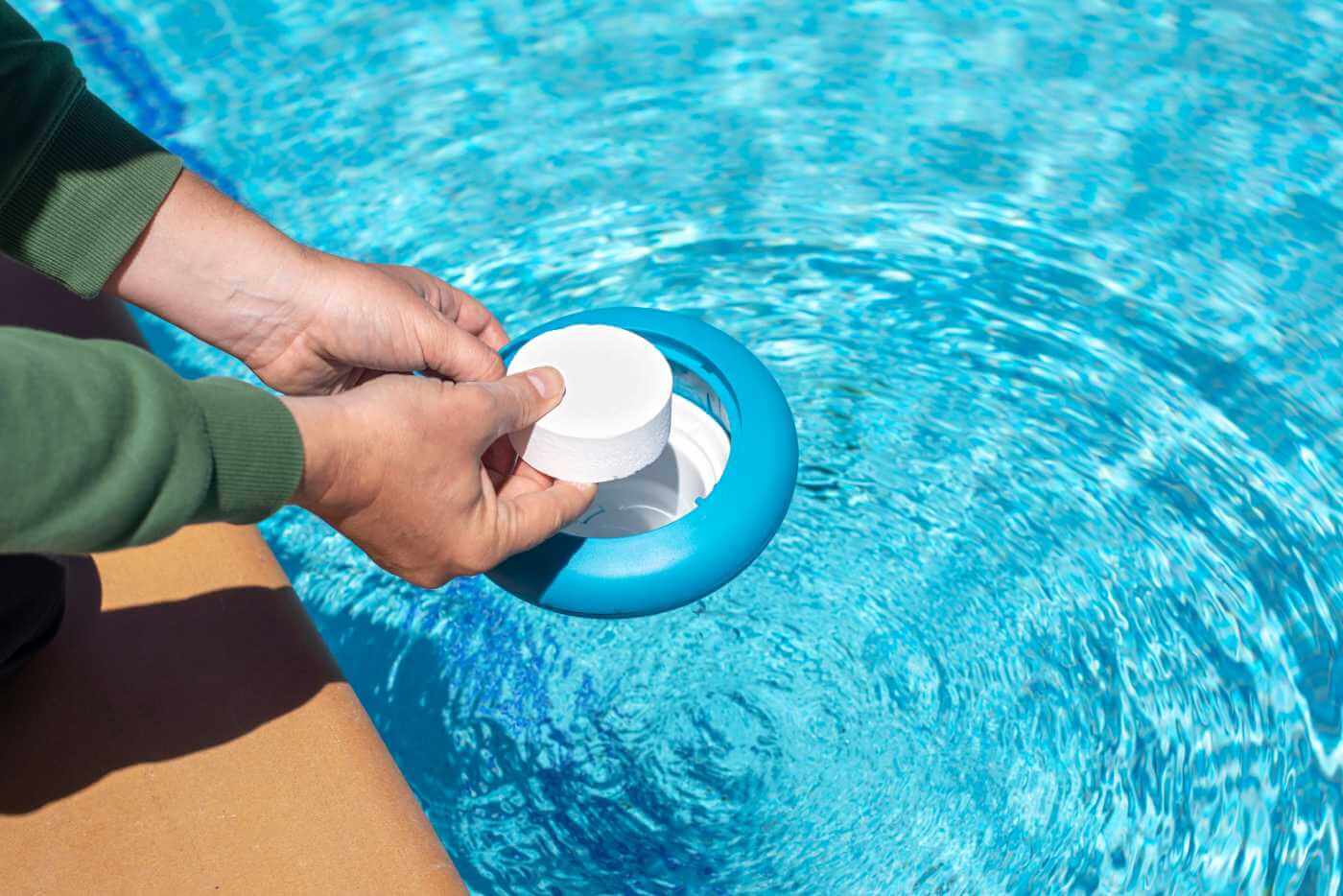
With summers in Austin seeing 40+ days of triple-digit heat, your pool chemistry has likely taken a hit. Evaporation and overzealous addition of chlorine tablets battling the Texas sun will result in sky-high CYA. The recommended level of CYA for a chlorine pool is around 30 to 50 parts per million. After a hot summer, the level of CYA in the pool is likely to have increased if you are using chorine tablets. Let’s review together what can be done about it and what the long-term solutions could be.
What is CYA? Why should you care about it?
CYA (Cyanuric Acid) is a necessary chemical in your pool. It acts as a chlorine stabilizer to protect the chlorine from being quickly destroyed by the sun’s ultraviolet (UV) rays. It is basically sun block protecting your chlorine. Without CYA, your pool will consume much more chlorine and is likely to turn green very fast.
What Happens If CYA Is Too High in Your Pool?
CYA is introduced to the pool from DAY 1 during the start up process. It ensures chlorine effectiveness to sanitize the pool. The issue is that all good things in excess are bad, and it is the same for CYA. When the CYA level in your pool reaches 100 parts per million it’s time to take steps to avoid chlorine lock and keep your pool healthy.
What Causes High Cyanuric Acid in Pools?
Most likely the CYA level in your pool has gone high due to the routine use of chlorine tablets (trichlor tablets). When you add a chlorine tablet to your pool it dissolves and releases chlorine AND cyanuric acid into the water. As you can imagine, if a chlorine tablet is the main sanitizer you use it won’t be long before the CYA level in your pool has increased significantly.
This is a problem that all chlorine pool owners face – we need to use chlorine tablets to make sanitizing the pool easy, but those tablets add stabilizer to the pool water continuously. For an average summer season of routine chlorine tablet use your CYA can easily go from the perfect range of 30-50 ppm all the way to 100 ppm or more!
And remember – all other forms of chlorine are safe:
- Liquid chlorine (sodium hypochlorite) – NO stabilizer added
- Cal-Hypo shock (calcium hypochlorite) – NO stabilizer added
At Aqua Clear Pool Care we never use chlorine tablets in the fall and winter months which helps our customers avoid high cyanuric acid in the spring.
What Happens If CYA Is Too High in Your Pool?
If cyanuric acid levels reach 100 or more parts per million in your pool it can create serious problems, such as:
1. Chlorine Works Inefficiently With a high CYA level you can experience what is called “chlorine lock” where the chlorine in your pool is not sanitizing the water effectively even though your chlorine test strip or color chart indicates that the chlorine level is where it should be.
2. Algae Growth Even With Good Chlorine Reading You may notice that algae begins to grow in your pool even though the chlorine is at a good level, when the CYA is above 100 ppm. In this case, the stabilizer acts as a barrier to protect bacteria and algae from the chlorine.
3. Pool Closure (Commercial Pools) In Austin, if a commercial or community pool is inspected and the CYA is found to be 100 or more it will be closed for that reason and the pool must reduce the CYA level before it can reopen.
4. Pool Turns Green Your backyard paradise could turn green from lack of effective chlorine sanitization and you will need extensive treatment and possibly expensive remediation.
How to Lower Cyanuric Acid in Pool Without Draining
Once the CYA level in the pool has reached 100 parts per million or more. You need to start addressing the issue to avoid a chlorine lock and having your backyard oasis turn green. Here are four methods to reduce high cyanuric acid, including three ways to lower CYA without draining your pool:
1. GreenStory Global CYA Remover
GreenStory Global has an interesting product that you can fit in your skimmer basket to filtrate the CYA away. This is simple to use as you just need to place the pouch in the skimmer basket. The main pump will have to run 24 hrs a day for the duration of the treatment. During the treatment, you need to shut down your chlorinator and use liquid chlorine only to supplement the pool.
Not everyone reported success with it, it is expected that once pouch can remove up to 40 parts per million of CYA in your pool. If the CYA level is very high, you may need more than one to get your pool back to the ideal range (30 to 50).
2. Bio-Active Cyanuric Acid Reducer:
If the pouch from GreenStory is not working, you can try the chemical from Bio-Active. This is a solution that will reduce cyanuric acid by up to 50% without draining your pool. For this treatment to be successful, there are a few conditions that need to be met:
- Water Temperature above 65 degrees
- Low Chlorine environment
This is something that we recommend for the fall or winter in Texas as algae could grow rapidly when the water temperature is above 77 degrees.
3. Reverse Osmosis:
Reverse osmosis (RO) for a pool is a mobile filtration service that removes dissolved solids like calcium, salt, and cyanuric acid from pool water by pumping it through a system of semi-permeable membranes. This process purifies the water, lowers chemical imbalances, and conserves water by allowing you to recycle up to 85% of the pool’s existing water instead of draining and refilling it.
It’s not cheap ($1500++) but this service corrects more issues than just CYA levels AND spares you the hassle of draining your pool. RO is ideal for Austin pool owners with our hard-as-rock city water—it removes calcium and mineral buildup (hello white “scale” lines on tile!) for a complete chemistry overhaul in 1 service. The area’s leading reverse osmosis provider? Aqua P.R.O. of course.
This process can be costly (from $1500) but it addresses more than just the CYA issue and avoids draining the pool. RO is ideal for Austin pool owners with our hard-as-rock city water—it removes calcium and mineral buildup (hello white “scale” lines on tile!) for a complete chemistry overhaul in 1 service. The area’s leading reverse osmosis provider? Aqua Clear Pool Care of course.
4. Dilution:
The old school solution is to dilute the CYA from the pool. This involves draining part or all the water in the pool and pressure washing the walls to remove the CYA from the plaster. This can be expensive and difficult to achieve as it is forbidden in most cities to drain a pool to sewage.
Needless to say, we don’t drain pool water into the street drains or storm drains in Austin (it violates city environmental ordinances). We route all of our water through the sanitary sewer cleanout so our local Texas lakes & rivers can stay clean and safe!
A drain-and-fill will also remove all those extra nutrients hiding in your calcium hardness and mineral buildup that lead to algae. Noticed white or “purple cyanurate” crusty looking crystals on your tile or in your pool cleaner? Pool chemistry in Austin built up too high and needs to be reset by draining.
Ideally, a service company will come with a sump pump to drain the water and then pressure wash the wall. Once this is done, the pool can be refilled.
Hard water is prevalent in lakeside communities like West Lake Hills and Lakeway so you’re not alone if you’re experiencing this. Either way, don’t brush it off – those crystals are trying to tell you something! Let Aqua Clear Pool Care know you need a pro drain-and-clean or set you up on a salt system to break the CYA cycle for good.
Tired of dealing with CYA issue? Let’s discuss options
You probably do not want to have to go through this process every year or every 2 years. Here are long-term solutions to prevent high cyanuric acid in your pool:
- Convert the pool to a saltwater pool – Saltwater pools love higher CYA (60 to 80) and as the salt gets converted to chlorine by the salt cell, you won’t need to add chlorine tablets any more.
- Automate your chemistry and rely on liquid chlorine with products like Pentair Intellichem or the Hayward CAT controllers
- Install a CCH® 73100 Endurance Calcium Hypochlorite (Cal-Hypo) Tablet Feeder for Pools and start using chlorine tablets without CYA.
Frequently Asked Questions
What causes high cyanuric acid in pool?
Chlorine tablets (trichlor) are by far the biggest source of CYA. Each tablet dumps a little stabilizer into your water and your CYA builds up over time. Liquid chlorine and cal-hypo shock have zero CYA.
How to lower cyanuric acid in pool without draining?
You can lower CYA without draining with: (1) GreenStory CYA remover pouches in your skimmer, (2) Bio-Active chemical reducer to remove up to 50% of CYA, or (3) Reverse osmosis filtration which recycles 85% of your existing water.
Why is cyanuric acid high in my pool?
Your CYA is high because every time a chlorine tablet dissolves, more stabilizer is added to your water. CYA can quickly go well above the 30-50 ppm ideal range during a summer season of regular tablet use.
What happens if CYA is too high?
Once you reach 100 ppm and beyond, chlorine becomes less effective and we call it “chlorine lock”. You can still get algae with what you think is enough chlorine and your pool will turn green. Public pools in Austin will be shut down by Health Dept if CYA is over 100 ppm.


Leave a Reply