
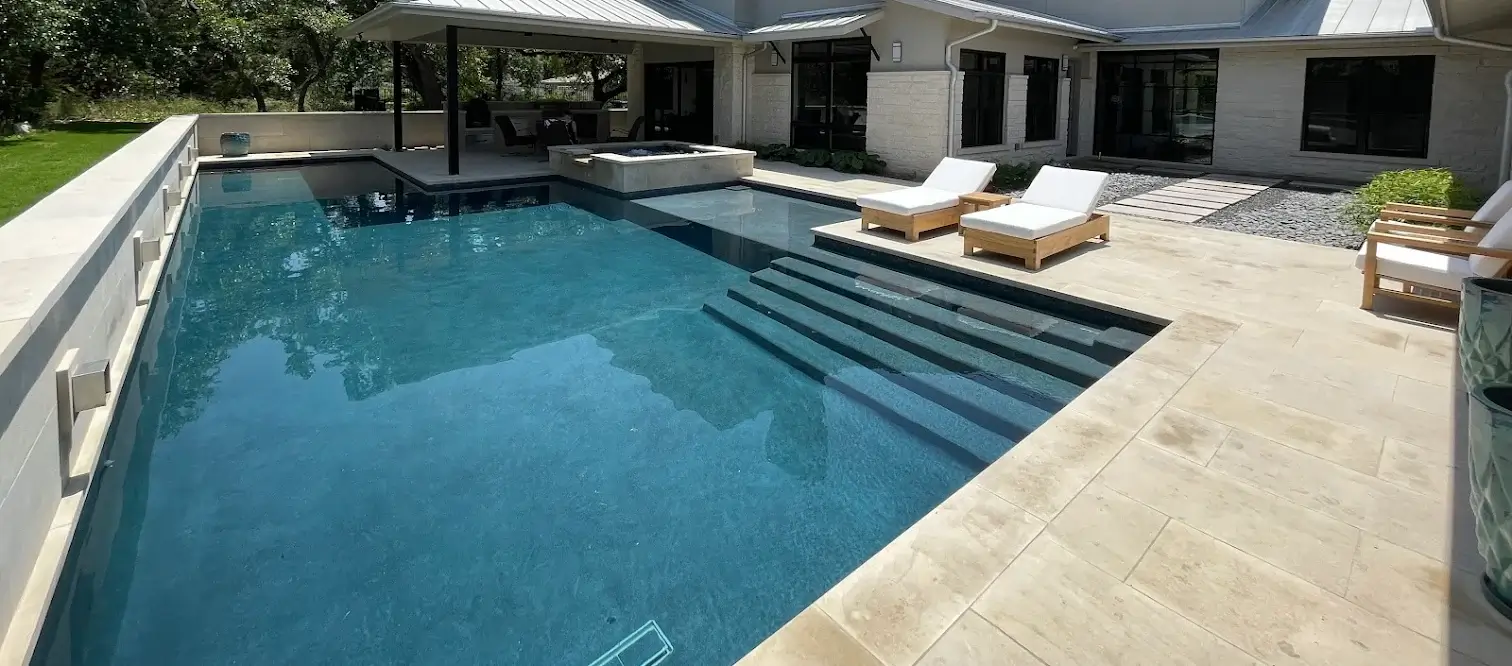
You’ve had enough winters in Austin to know this feeling. It’s the first week of June, and your weather app has been telling you 102°F for the past 10 days straight. You also own a backyard pool, one that looked crystal clear just one week ago, that’s starting to appear green.
Austin summers wreak havoc on pool water like nowhere else we know. Hot temps, intense sunshine, high humidity, and kids running through your backyard all afternoon don’t exactly equate to a healthy swimming environment. Once we hit prolonged stretches of 100-plus-degree days, your pool’s chemistry can change overnight. Your chlorine can disappear before you even get to add it. Pool temps reach warm levels where algae thrive. And between the heat, sun, and UV rays and summer activity levels, swimming pool maintenance can really feel like a full-time job.
Don’t worry. With a little planning and preventative maintenance, you can keep your pool water clear from June to August without having to fight chemistry all weekend long. We’ve created this handy guide to help you stay on top of your pool game all summer long.
Mastering the Chemistry of Heat

Your Pool’s Friend and Foe: Chlorine & The Texas Sun
Chlorine kills bacteria, algae, and anything else that would otherwise make your pool gross. But chlorine has a major weakness: Ultraviolet (UV) sunlight. Even with Austin’s aggressive summer sun, you can lose 100% of your unstabilized chlorine to the sun in just a few hours of direct exposure. The stuff you put in your pool on Monday morning can be gone by Monday afternoon if you don’t use a stabilizer. UV destroys chlorine molecules so fast that cloudy or green pools on Sunday are often pools that looked perfectly fine on Friday.
Stabilizer, aka Cyanuric Acid
Luckily, there’s a compound called cyanuric acid (CYA) that is colloquially known as “stabilizer” or “conditioner.” Stabilizer bonds with chlorine and protects it from UV damage, allowing it to last much longer in your pool. Your CYA level should be maintained at 30–50 ppm during Austin summers. Anything below that and your chlorine will burn off too quickly. Above 80 ppm, and your chlorine will start to become “locked up” and unable to do its job. This is known as a chlorine lock. Test your CYA levels monthly and maintain them as needed. It’s one of the easiest things you can do to keep your pool water pristine all summer long.
Sunday Night Shocking: Weekly Resets
Weekends mean more people, and more bodies mean more work for your pool’s chlorine to do! Prevent weekend overload with Sunday night shocking. An oxidizing chlorinating shock will blast your way through contaminants and reset your pool water overnight. Add your shock on Sunday night (a cal-hypo or non-chlorine oxidizer works best) per the label instructions for your pool’s size. Let your filter run overnight, and your water will be crisp and clean for another week of swimming.
Special Note for Saltwater Pool Owners: Saltwater chlorine generators are becoming increasingly popular among Austin pool owners. These can be a great tool, but high evaporative rates in Texas can cause your salt cell to scale with calcium more quickly than you might expect. A scaled cell cannot produce chlorine efficiently, if at all. Check your cell for white, flaky buildup at least once every 30 days when temperatures are in the triple digits to ensure you’re producing the chlorine your pool really needs.
Not yet on salt? Converting your pool to a saltwater system is one of the best upgrades you can make for Austin summers. A salt cell continuously produces chlorine whenever your pump is running, so you get a steady, consistent chlorine level throughout the day, rather than the peaks and valleys that come with manually dosing a traditional chlorine pool. That consistency is a huge advantage during triple-digit stretches when chlorine demand is at its highest, your pool stays protected around the clock without relying on you to manually add chemicals every few days. Thinking about making the switch? Learn more about salt conversion.
Combatting Evaporation and Water Levels
How to Tell the Difference Between a Leak and Evaporation
It is possible to lose an inch or more of water per week to evaporation alone during an Austin heat wave. How can you tell if the drop in water level you’re seeing is normal, or if you have a leak? Perform the bucket test.
Place a clean 5-gallon bucket on a pool step so it remains submerged (important: it needs to be in the water to experience the same temperatures and conditions as your pool). Fill the bucket with pool water and mark the water level on the outside of the bucket with a marker. Next, mark the water level on the pool wall next to the bucket. Wait 24 hours and then compare the two water levels. If both water levels dropped at the same rate, your water loss is from evaporation. If your pool water line dropped more than the bucket water line, you may have a leak that needs to be investigated.
Tips for Maintaining Correct Chemistry During Fill-Ups
One thing most pool owners don’t realize is that every time you top off your pool, you are diluting your pool water with local municipal water chemistry. Whether you’re filling up in Round Rock, Cedar Park, or right here in Austin, the water is moderately hard and has its own pH, calcium level, and alkalinity profile. So if you top off your pool several times over the summer, you can slowly begin to creep up in PH and have higher than normal Calcium Hardness levels. High calcium hardness causes scaling on tile lines and cloudy water, and can irritate the eyes. Test your calcium hardness once a month during the summer, and use a calcium reducer or a refill strategy if it is above 400 ppm.
Make sure your Auto-fill Valve is Working Properly
If you have an automatic fill valve for your pool, don’t just assume that it’s working. Failures and valve stuck in the closed position are common. Also, waterline debris can clog these valves, preventing them from functioning properly. During an Austin heat wave that produces several days in a row of 100 degree weather, it only takes a couple of days for your pool water level to drop below your skimmer opening. When your water level drops below this point, your pump will begin to pull in air instead of water. Running your pump without water for even a short period can burn out the pump motor and cost you hundreds to thousands of dollars in repairs. Test your auto-fill weekly during the summer months to ensure the water level does not drop below mid-skimmer.
Circulation and Filtration Strategy
Runtime: Follow the “1 Hour Per 10 Degrees” Rule of Thumb
Our simple runtime rule of thumb for Texas summers: run your pump 1 hour for every 10°F of outside temperature. So, if it’s 100°F outside, run your pump 10 hours per day. If it’s 105°F outside, run it 10–11 hours per day. The more you can cycle your water, the more filtered your water will be. Chemicals will also be distributed evenly, reducing the time algae have to cling to surfaces and bloom in dead spots.
Tip: Circulate at Night to Cool Off Your Pool Water
One little-known trick for staying cool in the summer is running your filter during the coolest hours of the morning. When the sun goes down, the water you lose to surface evaporation will naturally cool the remaining water in your pool. Running your pump overnight between 2: 00 AM and 6:00 AM is ideal to distribute that cool water where it needs to go. Sure, your 92°F pool won’t magically become a crisp 80°F oasis, but it’ll help give you that extra “hop” in the morning swims.
Do a Mid-Season Filter Cleaning
Your pool filter works the hardest when your pool does, too. That’s why peak season between Memorial Day and Labor Day is the toughest on pool filters. Don’t wait until your pressure gauge’s “high pressure” alarm goes off. Cut your filter some slack and give it a deep clean around midsummer. July 4th is as good a day as any. Backwash your sand filter thoroughly. Remove your cartridge filter(s) and soak them overnight in filter cleaning solution. Backwash your DE filter, then recharge with new DE powder. A clean filter won’t just work better, it’ll ease the workload on your pump motor and help your equipment last longer.
We love summer and want you to enjoy your pools as much as we do! These tips will help you stay on top of your game and keep your pool up and running all season long. As always, if you have any questions or run into any problems, give us a call. We’re here to help and will do whatever we can to keep your pool sparkling!
Beating the Algae Bloom Before It Starts

Phosphates: Algae’s Fuel Source
Phosphates enter pools all across Central Texas from several angles: lawn clippings carried by wind during a backyard mow, runoff from landscape fertilizer, especially common in the lush yards of Georgetown following an occasional summer rain storm, and airborne dust and pollen. If phosphate levels get too high, it’s inviting algae in. Swimming pools with adequate chlorine but high phosphate levels can experience chronically cloudy water and algae that just won’t quit. Test your phosphate levels monthly in the summer and treat with a phosphate remover if they are above 100–200 ppb. The phosphate remover will bind with the phosphates and help starve the algae before it even starts.
Brushing: Don’t Neglect This Crucial Step
When your water looks clear, it’s easy to forget about brushing. Even if your water is clear and chemically balanced, algae can start to grow unseen as a biofilm on your pool surfaces. This is most common in corners, behind ladder rungs, on the waterline, and in the grooves of pool steps. You can’t see it now, but that biofilm is phase 1 of an algae bloom. Regular brushing (weekly) with a stiff-bristled wall brush breaks up that biofilm before it forms, releasing it into the water column where your chlorine and filter can do their job.
Algicide
Using an algicide as a preventive measure, in addition to your regular pool maintenance, is cheap insurance against algae – especially during the peak summer months. Pick up a polyquat-based algicide (not copper, which can stain certain pool surfaces) and add it once per week or twice per month as directed. It won’t replace proper chlorine maintenance and filtration, but it adds an extra layer of protection during the time of year when algae is most likely to occur. A small dose every week prevents a lot of trouble down the road.
Pro Tips for the Austin Lifestyle
The Party is over: now what?
Austin likes to BBQ in the backyard, and summer pool parties are inevitable. But after a large gathering in your pool – even a fun, well-controlled one – there’s a lot of sunscreen, body oils, sweat, and other organic material loaded into your water. Here’s the post-party protocol:
- Skimmer Baskets – Check ’em and empty them. They will be full.
- Add chlorine or non-chlorine shock that night.
- Run your filter 2-3 extra hours overnight.
- Check your chemistry the next morning before letting anyone swim again.
Pet Hair and Filter Pressure: A Texas Dog Owner’s Reality
Labradors, goldens, Aussies. Texans love our dogs. And let’s face it, most of our dogs love our pools too. Pool professionals loathe pet hair because it wreaks havoc on filtration systems. Ten minutes of a big dog swimming wildly can fill your skimmer basket and dramatically increase your filter pressure. If Fido or Fluffy take daily dips in your pool, expect to empty skimmer baskets daily during peak season, rinse your cartridge filters twice a week instead of once, and throw a skimmer sock in your skimmer to catch loose hair before it goes down the waterfall. Trust us, your pump will run smoother!
Keep it Cool: Managing Water Temperature.
We don’t always have control over water temperature, but we can take steps to keep it down. If you’ve measured your water temperature and find that it’s hovering around 95°F, take a few steps to shade your pool. This doesn’t mean you have to invest in a bunch of pool covers. On very hot days, simply placing a large cantilever umbrella over part of your pool or investing in a sail shade, a popular choice for those breezy hill country backyards in Lakeway, will decrease the water temperature by several degrees. Not only will this help slow evaporation, but it will also make your water feel cooler and more comfortable. Shading won’t change your chemistry woes, but it will lessen the burden on your pool.
Consider a Pool Chiller for Serious Heat Relief
If you want to take water temperature control to the next level, a dedicated pool chiller is worth considering. Unlike passive shading solutions, a pool chiller actively lowers your water temperature, and that matters more than just comfort. Cooler water is a direct weapon against algae: algae thrive in warm water, and dropping your pool temperature even a few degrees can significantly slow algae growth and reduce the chemical demand on your chlorine. It also means more swim time. Nobody wants to jump into a 95°F bathtub in the middle of August. A chiller connects to your existing equipment pad and works alongside your pump to keep water at a consistently comfortable and algae-resistant temperature all summer long. Interested in adding a chiller to your setup? Learn more about pool chillers.
Your 100-Degree Game Plan
There is no magic formula for maintaining a blue pool in Austin’s triple-digit summer. The pools that stay attractive from June through September are not the ones that reach for the hose when something looks off. They are the ones cared for by owners (or pool professionals) who prioritize proactive maintenance over reactive repairs, saving both time and money in the long run. It’s faster. It’s cheaper. And it’s a lot less stressful.
Here’s your game plan: stabilize your chlorine levels. Test your water once a week. Shock every Sunday night. Brush your walls. Control your phosphates. Run your pump more often. Kill the algae before it has a chance to grow. Follow those simple steps week after week, and you’ll have the best-looking pool in the neighborhood all summer long.
Prefer Swimming Over Scrubbing?
Don’t want to spend your summer fussing with chemicals? Let Aqua Clear Pool Care do the heavy lifting. We’ll take care of everything, including weekly chemical maintenance, water balancing, brushing, skimming, filter cleaning, equipment maintenance, etc., so you can get outside and soak up your prized possession.
Call or text Aqua Clear Pool Care today to schedule your summer chemical inspection or get a free quote for weekly maintenance. We serve all of Austin and the surrounding areas because every Central Texas family should have a clean pool ready for those warm-weather months.


Leave a Reply