
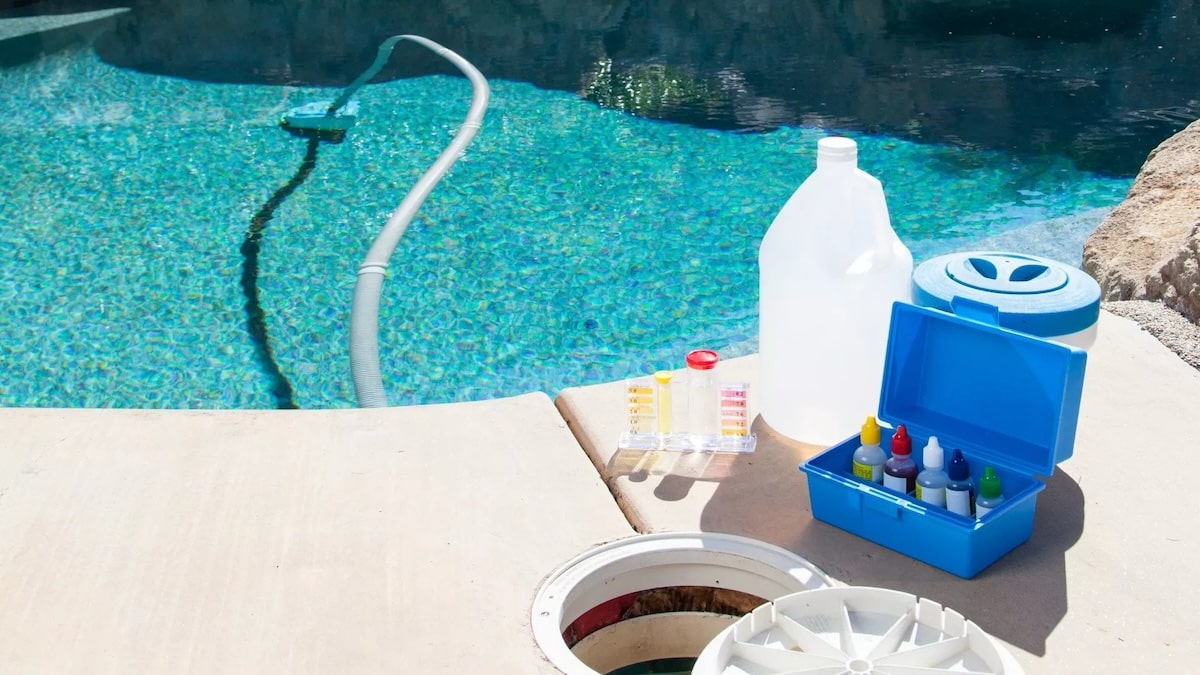
Few things are more Austin than relaxing by the pool on a blistering Texas day. But there’s nothing worse than rolling out the patio door to murky, green, or otherwise uninviting pool water on your weekend.
Maintaining proper water chemistry can seem overwhelming for the beginner pool owner. Not only is it extremely frustrating to have your numbers wrong, but it also leads to unsafe swimming conditions, algae outbreaks, and expensive pool equipment damage.
Luckily, pool chemistry doesn’t have to be so daunting. We’ve simplified the basics and broken them down into easy to understand concepts so you can know exactly what your pool needs to stay blue and beautiful all season long.
The Big 5 of Water Balance

Almost everything about clean, safe water comes back to five fundamentals. Master these, and you’re most of the way there.
1. pH Levels — The Comfort Factor
Simply stated, pH lets you know how acidic/basic your water is on a scale that should be maintained between 7.4 and 7.6.
Why pH matters: If your pH is too high, you will experience cloudy water and scale build-up on walls/floors/pipes/equipment. If it gets too low, your water will become corrosive, meaning it will damage your pool equipment and irritate swimmers’ eyes. That“burning eyes” effect people mistake as chlorine is, 99% of the time, a pH issue.
2. Alkalinity — The Bodyguard for pH
Total alkalinity acts as a buffer for your pH, keeping it from fluctuating too much. Your target range for total alkalinity is 80–120 ppm.
This affects your pH stability. Without enough alkalinity, your pH will fluctuate all over the place, and nothing you add will make it happy. Remember this mantra: Always adjust alkalinity levels before you adjust pH. Get the buffer right, and controlling pH will be far easier.
3. Sanitizer — The Protector
This is your chlorine (if you have a traditional pool) or salt level (if you have a saltwater pool where you have a salt cell that automatically makes chlorine for you).
Why it matters: Well, this is what actually kills the bacteria, viruses, and algae in your water. pH and alkalinity don’t matter if you don’t have an active sanitizer to keep your water swimmable. Optimal chlorine levels are 1–3 ppm in winter and 3–5 ppm in summer. For saltwater pools, optimal salt levels depend on your equipment brand: Jandy and Hayward systems run best at 3,200 ppm, while Pentair systems need 3,600 ppm.
4. Cyanuric Acid (CYA) — The Sunscreen for Your Chlorine
CYA, also known as pool stabilizer, acts as sunscreen for your chlorine. Without it, the Texas sun will burn through your chlorine in a matter of hours. Your target CYA range is 30–50 ppm for traditional chlorine pools and 60–80 ppm for saltwater pools. Too little CYA and your chlorine disappears. Too much and your chlorine becomes less effective at killing bacteria and algae.
5. Calcium Hardness — The Scale Prevention Factor
Calcium hardness measures the amount of dissolved calcium in your water. Your target range is 200–400 ppm. If calcium hardness gets too low, your water becomes aggressive and will start pulling calcium from your pool surfaces, etching plaster and damaging tile grout. Too high, and you get the chalky white scale buildup that Central Texas pool owners know all too well. This is especially important to monitor given how hard our local tap water is.
Central Texas will Mess with Your Pool Water
Maintaining proper pool chemistry isn’t easy anywhere, but Mother Nature in Central Texas can make it particularly difficult. While a lot of online information about keeping pool chemicals balanced will apply here in Austin, we have a few extra factors to worry about.
UV Rays: We’ve got some of the strongest sunlight in Texas, which means our chlorine doesn’t stand a chance if we don’t protect it. Cyanuric Acid, sometimes known as pool stabilizer, protects your chlorine from sunlight. This “sunscreen” for your pool helps your chlorine last longer and is essential for Austin summers.
Pollens and debris: Pollen from our glorious cedar and oak trees, especially around tree-dense areas like West Lake Hills and Bee Cave, blankets the area in spring. Throw in Texan thunderstorms that can dump massive amounts of debris (and rainwater) into your pool overnight, and it’s easy to see how weekly water testing is more crucial here than in other areas.
Hard water: Whether your pool is filled from Austin City water or up in Georgetown, Central Texas tap water is notoriously ‘hard’ and high in calcium. Without proper pH levels, calcium hardness can leave you with chalky build-up on tiles and pool equipment. Maintaining a pH level of 7.4–7.6 is your best defense against calcium hardness.
Essential Chemicals, Demystified
Here’s what actually goes into balanced water:
- Chlorine tablets / liquid chlorine — the sanitizer that kills bacteria and algae
- Granular shock (Cal-Hypo) — a high dose of sanitizer to quickly destroy contaminants
- Salt — used in saltwater pools to create chlorine using your salt cell
- Soda ash — used to raise pH if it gets too low
- Muriatic acid — used to lower pH and alkalinity when they rise too high
- Sodium bicarbonate — used to raise alkalinity (the buffer for your pH)
- Cyanuric Acid (CYA/stabilizer) — used to prevent chlorine loss from the Texas sun
- Diatomaceous Earth (DE) — what coats and powers your DE filter
What most people learn the hard way (when faced with an empty bucket of muriatic acid at home) is that ALL the chemicals are included in Aqua Clear’s flat rate pricing. Everyday pool chemicals. So you never have to buy, measure, or store harsh chemical jugs in your garage again. We handle all the heavy lifting and safety concerns for you.
What Bad Chemistry Really Costs You
Neglecting your water chemistry isn’t just ugly. Learn what bad pool chemistry does:
- Algae. Algae blooms can devastate a clear pool in the blink of an eye. It’s common for pools to turn green within one or two days of chlorine reaching zero. And once algae starts growing, eradicating it can be difficult.
- Equipment breakdown. Acidic, imbalanced water corrodes your pool pump, heater, and filter until they no longer work. And did you know that replacing a damaged pool pump costs significantly more than routine chemical balancing? Regular preventative care keeps your hardware running for years. (If you do need a new pump, Aqua Clear’s team is RAIL-certified to handle those electrical repairs safely.)
- Swimmer discomfort. Irritation, itchy eyes, rash, and swimmer’s ear are just a few side effects of poorly balanced pool water. Keep your water gentle and safe, so your family and friends can spend the weekend relaxing, not dealing with stinging eyes or itchy skin.
Your Simple Weekly Routine
If you’re going to do it yourself, remember that a regular maintenance schedule prevents minor problems from becoming major:
- Check your water once a week at a minimum (or more often during hot summer days/storms).
- Clear your skimmer baskets, brush walls, and vacuum to remove organic matter (before it consumes your chlorine).
- Backwash your filter once a month to ensure proper circulation.
Stay on top of it, and maintenance will be easy. Fall behind, and you’ll be constantly playing catch-up (just when you want to be swimming).
Why Stress Over Chemistry? Leave It to the Experts
Here’s the thing: Owning a pool shouldn’t require a part-time job.
Imagine it’s Friday afternoon and the Texas heat is full force. You open up to your balanced and clean pool that’s ready for weekend fun. No chemicals lined up in your garage and no testing or guessing. That’s what our weekly pool maintenance service is all about.
Here’s how Aqua Clear is different from the rest:
- We text before arriving so you’ll always know when we’re on our way.
- You’ll receive an email with pictures detailing everything we did at your home, your exact chemical levels, and anything we added after every visit.
- We specialize in Austin’s seasons, water, and weather.
Never worry about whether your pool is safe or balanced. Just enjoy it.
Say goodbye to guessing about pool chemistry. Aqua Clear Pool Care will take care of the details so you can enjoy the swim. Serving all of Greater Austin from Lakeway to Round Rock and beyond. Call today to receive a free quote on weekly maintenance!


Leave a Reply