
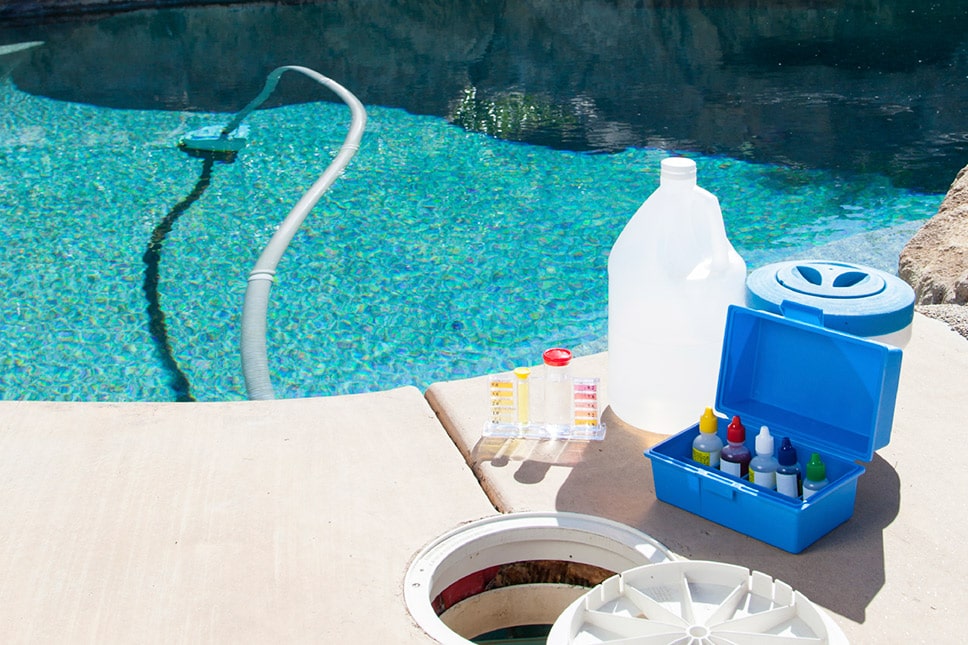
As a pool owner in Central Texas, you understand that your only chance of making it through a 105° F August afternoon is by having a clean and inviting oasis in your backyard. Between the pollen dumps from the spring live oak season and the beating sun Texas summers bring, keeping your pool water clear may seem like a job in itself. Routine pool maintenance using carefully chosen chemicals will help keep your pool healthy and safe for everyone.
Here, we explore the 9 best pool cleaning chemicals. These products will give you water so you can enjoy your swim safely.
Pool Chemistry 101
PH, alkalinity, sanitizer levels and calcium hardness are important numbers if you want a clean pool. Buy testing kits and keep track of these numbers every day.
Key Chemical Balance Aspects
- PH Levels: This measures how acidic/basic our pool water is. We want this between 7.2-7.8. Maintaining good pH will allow your sanitizer to work and it also prevents eye/skin irritation.
- Alkalinity: Total alkalinity refers to the pH buffer of water. We want this to be around 80-120 ppm. Good alkalinity helps prevent pH from fluctuating wildly.
- Sanitizer Levels: Chlorine & bromine are the two most common sanitizers used to kill bacteria. Ideal chlorine levels should be 1-3 ppm, bromine 3-5 ppm.
- Calcium Hardness measures the amount of dissolved calcium in our pool. Keep calcium hardness between 200-400 ppm to prevent corrosion or scaling on pool surfaces.
Testing Kits
Testing kits allow us to measure pH, alkalinity, sanitizer levels, and calcium hardness.
- Types of Kits: Test strips and liquid test kits. The test strips are faster than liquid kits which measure more accurately.
- Frequency of Testing: We should test our pool water at least once a week or more often during heavy use or after rainfall. This way, we can react quickly to any chemical imbalances.
- Interpreting Results: We must understand the numbers. If our pH is too high, we can use a pH reducer. If sanitizer levels are low, we need to add more chlorine.
pH Control: Keeping Pool Water Balanced
The ideal pH range is one of the most important parameters to control in order to maintain swimmer comfort, chlorine effectiveness, and prevent scaling or corrosion. Maintaining pH between 7.2 – 7.8.
Lowering pH: Muriatic Acid
- Use: Reduces high pH and alkalinity.
- Pros: Fast-acting, prevents scaling.
- Cons: Highly corrosive, requires careful handling.
- How to Use: Dilute in water, add near a return jet, and test after a few hours.
Raising pH: Soda Ash (Sodium Carbonate)
- Use: Increases pH without drastically affecting alkalinity.
- Pros: Quick and effective.
- Cons: Overuse can cause cloudy water.
- How to Use: Pre-dissolve in water, add to the deep end, and retest after a few hours.
Alkalinity Control with Sodium Bicarbonate
Total Alkalinity (TA) stabilizes pH and should be kept between 80 and 120 ppm to prevent water balance issues.
Raising Alkalinity: Sodium Bicarbonate (Baking Soda)
- Use: Increases TA while slightly raising pH.
- Pros: Safe, prevents pH swings, and easy to apply.
- Cons: Overuse can raise pH too much or cause scaling.
- How to Use:
- Add 1.5 lbs per 10,000 gallons to raise TA by ~10 ppm.
- Dissolve in water or sprinkle evenly with the pump running.
- Retest after 6 hours and adjust if needed.
The 9 Best Pool Cleaning Chemicals For A Clear Pool
- Chlorine
What it does: kills bacteria, viruses, and algae. There are many problems that can arise in your pool water and chlorine is what keeps it clean. Comes in tablet, liquid, and Cal-Hypo forms.
Chlorine Tablets (Trichlor)
- Purpose/Function: Slow-dissolving sanitizer that releases a constant level of chlorine. Most contain a stabilizer(cyanuric acid). The stabilizer helps prevent chlorine loss due to Ultra Violet sunlight breakdown.
- Pros:
- Convenient and easy to use.
- Long-lasting and ideal for maintaining consistent chlorine levels.
- Works well in floating dispensers or automatic feeders.
- Cons:
- Can lower pH and alkalinity over time.
- Requires monitoring to avoid excessive stabilizer buildup.
- Best For: Regular pool maintenance in residential pools.
Liquid Chlorine (Sodium Hypochlorite)
- Purpose/Function: Fast-acting chlorine that quickly raises chlorine levels in pools. It does not contain a stabilizer.
- Pros:
- Effective and easy to dose.
- Doesn’t leave behind residue or buildup.
- Ideal for shock treatments or frequent chlorination.
- Cons:
- Shorter shelf life compared to other forms.
- Can raise pH, requiring adjustment with acid.
- Heavier and bulkier to store and transport.
- Best For: Large pools, commercial pools, or those with automated liquid feeders.
Calcium Hypochlorite (Cal-Hypo)
- Purpose/Function: Granular chlorine with a high percentage of available chlorine. Commonly used for shocking pools.
- Pros:
- Strong and effective for eliminating contaminants and algae.
- Longer shelf life than liquid chlorine.
- No stabilizer so that it won’t contribute to excessive cyanuric acid buildup.
- Cons:
- Can increase calcium hardness over time, potentially leading to scaling.
- Requires pre-dissolving in water before adding to the pool.
- Can be hazardous if not stored properly.
- Best For: Weekly shock treatments or pools with low calcium hardness.
- Safety Tip: When using chlorine, never combine it with any other chemicals. Keep out of reach of children and pets and in a ventilated area. Use gloves and eye protection to protect yourself.
2. Diatomaceous Earth (DE) Powder
DE is short for diatomaceous earth, which is the filter media used in DE pool filters. This powder-like substance is actually fossilized algae that filters DE pools to absolute perfection.
- Purpose/Function: Captures dirt and other particles as small as 2-5 microns.
- Pros: Top-notch filtration out of any pool filter media.
- Cons: Needs to be replaced after backwashing your filter. It can be messy to deal with and you shouldn’t breathe in the dust. Also, there are some areas where you are not allowed to dispose of it.
- Best For: Someone that wants the absolute best when it comes to clear pool water, and has a DE filtration system.
- Safety Precautions: Wear a mask and gloves when handling this product.
3. Algaecide
Algaecides are necessary to prevent and treat algae growth in our pools. Algae makes the water green and slimy. Trusty algaecide will allow us to keep our pool crystal clear. Particularly true here in Central Texas. Our live oak trees release fluffy tassels each spring and cedar trees shower us with pollen each winter. This stuff clogs up our skimmers and feeds those nasty algae blooms. All that organic matter is exactly what algae thrive on. So having a good algaecide is one of your best defenses against it.
Purpose/Function: Prevents and controls algae growth. Different types target different algae species.
Pros: This readily available preventative treatment will help maintain your water clarity.
The cons are that not every type will work with every algae strain, and overusing these products can cause staining in some cases.
Use As: A preventative solution to avoid recurring algae blooms.
Safety First: Always follow safety instructions. Do not overuse algaecides, and keep them out of the reach of children.
4. pH Balancers
To keep us comfortable and safe, we need to balance the pH of our pool water between 7.2-7.8. Too low and it will irritate our skin and corrode equipment. Too high and we’ll have cloudy water and less effective chlorine.
pH Increaser (Sodium Carbonate)
- Purpose/Function: Raises pool water pH.
- Pros: Easy to use, available.
- Cons: Sodium will raise your pool’s alkalinity, so don’t use too much.
- Best For: Adjusting your pool’s pH when it falls below the optimum range.
- Safety: Add small increments and retest the pH before adding more.
pH Decreaser (Sodium Bisulfate)
- Function: Lowers your pool water’s pH levels.
- Cons: Can lower alkalinity if used excessively.
- Safety Precautions: Add in small increments and retest pH before adding more. Wear gloves and eye protection.
5. Alkalinity Increaser
Total alkalinity buffers the pH levels in our pool. It helps stabilize pH changes, making maintaining a safe swimming environment easier. The ideal range for total alkalinity is 80-120 ppm.
Purpose/Function: Raises pool water total alkalinity, helps to buffer pH, and prevents large pH swings.
Pros: Easy to use, available.
Cons: Can raise pH if used excessively.
Best For: Adjusting pool water when total alkalinity is below the recommended range. Essential for pH balance.
Safety Precautions: Add small amounts in first, and retest alkalinity and pH before adding more.
6. Calcium Hardness Increaser
Calcium hardness impacts corrosiveness and scaling capacity of the water. Some areas actually require a calcium hardness increaser to hit this balance. However, here in Central Texas our water is already laden with limestone. From Georgetown to Cedar Park — and out in the Hill Country in Liberty Hill, Mason, or Hatch (Believe me, I know they all! ), your water has more calcium than you probably realize. You’re much more likely to have too much calcium than too little. Too much leaves that nasty white rim around your tile line and causes scaling on your equipment. Maintaining appropriate calcium levels between 200-400 ppm is crucial to protect your pool equipment.
Purpose/Function: Raises pool water calcium hardness and prevents corrosion of pool equipment and surfaces.
Pros: Effective for increasing calcium hardness.
Cons: Can cloud the water if added too quickly.
Best for: Adjusting pool water when calcium hardness is below the recommended range. Essential for pool infrastructure.
7. Phosphate and Enzyme Remover
Safety Precautions: Follow label instructions, usually by slowly adding to the pool’s deep end while the pump runs. Wear gloves and eye protection.
Phosphate remover and enzyme remover are like the unsung heroes of swimming pool sanitation.They work by breaking down organic contaminants that cause cloudiness and kill phosphates, which encourage algae growth. Combine these two characteristics and you’ve got a product that can prevent algae growth and decrease chlorine demand.All you need now is organic matter to try to turn your pool water green. If you live in an area surrounded by greenbelts and large tree canopies like West Lake Hills, Steiner Ranch, Lost Creek or Great Hills you know how much debris your swimming pool collects. All that leaf debris and pollen encourages algae growth which is why a high quality enzyme and phosphate remover like the Orenda CV-700 below is essential.
Purpose/Function:
- Phosphate removers eliminate phosphates, a primary food source for algae. They help keep pool water clear and reduce the need for algaecides.
- Enzyme removers break down organic contaminants, such as body oils, sunscreen, and lotions, improving filtration and water clarity.
Pros:
- Reduces algae growth and chlorine demand.
- Helps prevent scum lines and organic buildup.
- Improves water clarity and filter efficiency.
- Reduces the need for excessive chemical use.
Cons:
- May cause temporary water cloudiness as phosphates are removed.
- Some products require multiple treatments for high phosphate levels.
Best For:
- Pools with recurring algae issues or high bather loads.
- Those looking to reduce chlorine demand and improve overall water balance.
- Ideal for ongoing maintenance to keep water crystal clear and reduce the buildup of oils and lotions.
Suggested Product: Orenda CV-700
Remove phosphates and enzymes with Orenda CV-700. This phosphate remover features non-toxic, environmentally friendly enzymes with phosphate control. It helps keep pools cleaner longer, clearer, and easier to maintain. Orenda CV-700 breaks down non-living organics such as body oils, lotions, and sunscreen. It also removes phosphates, which promote algae growth.
Safety Precautions:
Always read and follow dosage directions. Wear gloves and eye protection. Keep pool water properly balanced before adding this product.
8. Stain Remover
Mineral stains, slime/debris buildups, or rust can cause our pool to look unattractive. Stain removers help to solve these problems specifically. There are many different kinds of stain removal we can use for different types of stains.
Purpose/Function: Used to eliminate stains that occur on pool surfaces from metals (i.e. iron, copper), organic contaminants, or other debris.
Cons: Many stain removers can be toxic and should be handled with caution. Be sure to pick one that works with the type of stain you have. Best used for: Stains on pool walls/floors or tile that are already there.
Safety Precautions: Read all label directions. Some products may need you to drain your pool or apply the product in a certain way. Wear gloves and eye protection.
9. Saltwater System Chemicals
You must regularly monitor and adjust the chemicals if you have a saltwater system. Saltwater systems produce chlorine, but we must also manage pH, alkalinity, and calcium hardness.
Purpose/Function: Provides the salt for a saltwater chlorine generator to produce chlorine for sanitizing your pool.
Pros: Saltwater pools need chlorine to function correctly. This provides a constant source of chlorine.
Safety Precautions: Store in a dry place. When adding salt to the saltwater system, follow the manufacturer’s instructions.
9. Cyanuric Acid (CYA)
CYA, which stands for Cyanuric Acid, is a chlorine stabilizer, or conditioner. Ultraviolet rays from sunlight will rapidly destroy chlorine if it is not protected by a stabilizer. Without a stabilizer your chlorine will lose it’s effectiveness much faster, and you will find yourself adding chlorine more often than you should have to. This can be especially crucial during the intense summers we experience in Central Texas. If you don’t use a stabilizer like Cyanuric Acid to protect your pool’s chlorine, then the harsh sun shining down on the backyard pools of Hutto, Buda, Kyle, or West Lake Hills can burn off your free chlorine within hours. This leaves your pool vulnerable during the sunniest part of the day.
Purpose/Function:
- Extends the lifespan of chlorine by shielding it from UV degradation.
- Helps maintain consistent chlorine levels, reducing the need for frequent dosing.
Pros:
- Protects chlorine, making it more efficient.
- Reduces chlorine consumption, saving money on chemicals.
- Helps maintain a more stable sanitizer level in outdoor pools.
Cons:
- Overuse can lead to chlorine lock, reducing chlorine effectiveness.
- Requires partial water dilution if levels get too high (>50 ppm).
- Not needed for indoor pools (no UV exposure).
Best For:
- Outdoor pools using liquid chlorine or unstabilized chlorine products.
- Those looking to reduce chlorine loss due to sunlight exposure.
- Maintaining chlorine efficiency during hot summer months.
Safety Precautions:
Handle with gloves to avoid dust inhalation, add small amounts to avoid overcorrection, and never mix directly with chlorine products.
Tips For Safe Chemical Handling And Storage
- Read The Label
We should always read and follow the label. Each chemical has its own handling and storage instructions. - Storage
Store chemicals in a cool, dry place. Separate different types of chemicals to prevent reactions. - Don’t Mix Chemicals
We never mix pool chemicals. Mixing can cause harmful reactions to ourselves or our equipment. - Wear Safety Gear
When handling pool chemicals, we must wear safety gear. This includes gloves and eye protection to prevent spills and splashes. - Proper Disposal
Dispose of unused or expired chemicals according to local regulations. We never throw them in the garbage or pour them down the drain. By following these simple tips, we can safely handle and store our pool cleaning chemicals ourselves and the environment.
Pool Cleaning Schedule
A regular cleaning schedule is key to a sparkling-clean pool. We recommend a schedule with daily, weekly, and monthly tasks.
Daily:
- Skim the surface for leaves and debris.
- Check the water level and adjust if necessary.
- Empty skimmer baskets.
Weekly:
- Vacuum the pool to remove dirt from the bottom.
- Brush the walls and tiles to prevent algae buildup.
- Test water chemistry, pH, and chlorine levels.
Monthly:
- Clean the filters.
- Shock the pool to kill hidden bacteria and algae.
- Inspect pool equipment
- Clean pool equipment as needed
Routine water chemistry checks will help you maintain adequate chlorine levels and pH balance. Little maintenance now will save you big problems later. Remember that weather can change quickly here in Central Texas. If a traditional Austin flash flood rains down on your backyard in Circle C or Cedar Park, you’ll want to test your water chemistry immediately. This will help you keep up with the abrupt changes in pH and dilution caused by all that water.
Let the Pros Handle the Austin Heat
To maintain crystal-clear waters all year round, you must choose the right cleaning chemicals. When choosing products, look for ones that are safe, effective, and easy to use. Important products to have are chlorine tablets for daily sanitizing, shock treatments to use after heavy swimmer use or rain, and algaecide to prevent algae growth. With regular upkeep, you’ll have a clean, safe, and inviting pool all season long.
Don’t waste your valuable weekend time driving all over town for chemicals or scrubbing algae in the hot sun. If you’re out in Spicewood or in the middle of Austin, let Aqua Clear Pool Care do the work while you enjoy your pool. Need expert help keeping your pool spotless? Let Aqua Clear Pool Care handle the maintenance for you! Contact us today for professional pool cleaning and chemical balancing.


Leave a Reply